

CORTEX2 in Stereopsia 2023: Pioneering XR and Immersive Telepresence
We proudly announce that we will participate in Stereopsia EUROPE, an eXtended Reality (XR), 3D, and immersive technologies event organized with the XR4Europe association, which builds upon the H2020 project XR4ALL.
An event where tech meets entertainment and business, gathering scientists, entrepreneurs and investors and featuring keynotes, thematic conferences, awards competitions, booster labs, B2B, an exhibition, and XR demos.
The event will take place from 18 to 20 October in Brussels, Belgium. CORTEX2 coordinator Alain Pagani will participate in the DG CNECT Workshop on 18 October at 2:00 p.m. and in the Presentation of the Horizon Europe and H2020 Projects session at 3:15 p.m.
He will share insights into our project's objectives and early results and announce the launch of our Open Call #1, aimed at recruiting and supporting XR innovators — from companies (tech startups/SMEs) to research institutions (universities, NGOs, foundations, associations) — to co-develop our innovative XR platform and engage new use cases to demonstrate its replicability in different domains.
This opportunity will allow us to show how we are using XR technology in practical scenarios, from industrial remote cooperation to business meetings and remote technical training. Also, to make ourselves known to a wider audience of XR specialists and stakeholders, showcase our innovations and boost our synergies in the European XR sector.
Take a look at the full event program and register now to participate.
https://www.youtube.com/watch?v=vNn_cOt3oOQ
to keep updated with our upcoming open call and next updates.

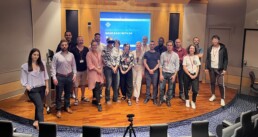
CORTEX2 2nd progress meeting in Athens
On 20-21 September 2023, we held our second Progress Meeting in Athens (Greece), hosted by our partner Intracom Telecom. It was a great opportunity to physically reconnect as a team, share our most outstanding achievements since CORTEX2 started a year ago, and align our next steps before launching our first open call in October 2023.
The meeting was packed with important discussions to further advance the development of our highly innovative XR (eXtended Reality) remote cooperation platform, an open, versatile, inclusive and scalable digital workplace for which we have used our partner Alcatel Lucent Enterprise's Rainbow teleconferencing solution as the backbone.
Also, to continue the preparation of our Open Call #1, through which we will recruit XR innovators to co-develop our platform and address new use cases that demonstrate its replicability in different domains. In total, we will invest €3 million to fund and support the 22 teams that will be part of our journey in this first phase of CORTEX2.
In addition, we had the opportunity to demonstrate some of the technical features of our collaborative platform — including a business meeting avatar, industrial remote cooperation and the integration of IoT (Internet of Things) devices — see the results of our work over the last few months and define our next technological developments.
Two days of intense teamwork and collaboration
Representatives from all partner organisations of our CORTEX2 team presented their developments in the fields of technology, ethics and psychosocial issues, and tested different prototypes, including a voice assistant, a VCAA-based avatar configurator (video image compression to reduce the load on data centres) and 3D environment reconstruction. Our partner Actimage GmbH, a Unity expert, also presented and tested its VR (Virtual Reality) solution.
Many thanks to our CORTEX2 team for their excellent sessions and a special thanks to our partners at Intracom Telecom for hosting us.
Commitment to teamwork, close collaboration and communication are key to achieving our goals. This meeting reaffirmed our vision — to democratise access to remote collaboration through XR — and allowed us to share learnings and recharge the energy we need to move on to the next exciting stage of CORTEX2. Here we go!
to keep up to date with our upcoming open call and next updates.

We announce the launch of our Open Call 1 at SIDO Lyon
We have participated in SIDO Lyon 2023, an event focused on exploring the convergence of the Internet of things (IoT), artificial intelligence (AI), extended reality (XR) and robotics technologies, and bringing together this ecosystem's key players for the last 9 years.
Our colleague Emmanuel Helbert, Innovation Manager at Alcatel-Lucent Enterprise, has been part of a round table on "XR and User Experience" on 21 September 2023, together with Patrice Reilhac (Valeo), David Gal-Regniez (Minalogic) and Thierry Sauvaget (PDG, AVA-UX).
He introduced our CORTEX2 project to a diverse audience — from tech solution providers to industrial groups, research laboratories, local authorities and institutions — and announced the launch of our first Open Call in October 2023, aimed at recruiting and supporting tech startups/SMEs and research-oriented institutions to co-develop our XR platform and replicate it in different domains.
See his complete intervention (in French) here:

Stay tuned for the launch of our first open call! to make sure you don't miss anything CORTEX2-related.

CORTEX2 at Sploro's Cascade Funding Info Day
In September 2023, we participated in Sploro's Cascade Funding Info Day. Our colleague Raquel Carro, leading our work on innovation strategy, dissemination, exploitation and FSTP from AUSTRALO, explained the keys to CORTEX2 and our first Open Call, which we will launch in October 2023.
It was a great opportunity to showcase CORTEX2 to an audience of innovators, entrepreneurs, researchers and organisations interested in funding opportunities like the ones we will offer. The Horizon Europe projects XR2Learn and UTTER also participated and shared their opportunities in the field of immersive technologies.
Don't miss out on our open calls, with which we'll recruit, fund and support EU tech startups/SMEs and industry players (RTOs, universities, associations, NGOs) to co-develop our extended reality platform and its replication in different domains.
Learn more in the presentation we made at the webinar (please note that some of the information is subject to change before our Open Call #1 launch):
https://www.youtube.com/watch?v=miql34g8wno
to keep updated with our upcoming open call and next updates.

CORTEX2 Publication: Dynamic Cost Volumes with Scalable Transformer Architecture for Optical Flow
Our paper “Dynamic Cost Volumes with Scalable Transformer Architecture for Optical Flow” was presented at the Irish Machine Vision and Image Processing Conference (IMVIP 2023).
Abstract
We introduce DCV-Net, a scalable transformer-based architecture for optical flow with dynamic cost volumes. Recently, FlowFormer [Huang et al., 2022], which applies transformers on the full 4D cost volumes instead of the visual feature maps, has shown significant improvements in the flow estimation accuracy. The major drawback of FlowFormer is its scalability for high-resolution input images, since the complexity of the attention mechanism on the 4D cost volumes scales to O(N^4), with N being the number of visual feature tokens. We propose a novel architecture where we obtain the FlowFormer-type enrichment of matching cost representations but using lightweight attention on the visual feature maps with quadratic (O(N^2)) complexity. Firstly, we generate sequential updates to the visual feature representations and, consequently, the cost volumes using lightweight attention layers. Secondly, we interleave this sequence of cost volumes with iterations of flow refinement, thereby modeling the update operator in our refinement stage to handle dynamic cost volumes. Our architecture, with two orders of computational complexity lower than that of FlowFormer, demonstrates strong cross-domain generalization on the Sintel and KITTI datasets. We outperform FlowFormer on the KITTI dataset and achieve highly competitive flow estimation accuracies on the Sintel dataset.
Authors
Vemburaj Yadav, Alain Pagani, Didier Stricker.
Read the full publication
Access all our CORTEX2 publications.

CORTEX2 Publication: X-RiSAWOZ: High-Quality End-to-End Multilingual Dialogue Datasets and Few-shot Agents
Our publication “X-RiSAWOZ: High-Quality End-to-End Multilingual Dialogue Datasets and Few-shot Agents” has been published at Findings of the Association for Computational Linguistics: ACL 2023. We will use the corpus from this work directly to train our conversational agent.
Abstract
Task-oriented dialogue research has mainly focused on a few popular languages like English and Chinese, due to the high dataset creation cost for a new language. To reduce the cost, we apply manual editing to automatically translated data. We create a new multilingual benchmark, X-RiSAWOZ, by translating the Chinese RiSAWOZ to 4 languages: English, French, Hindi, Korean; and a code-mixed English-Hindi language.X-RiSAWOZ has more than 18,000 human-verified dialogue utterances for each language, and unlike most multilingual prior work, is an end-to-end dataset for building fully-functioning agents. The many difficulties we encountered in creating X-RiSAWOZ led us to develop a toolset to accelerate the post-editing of a new language dataset after translation. This toolset improves machine translation with a hybrid entity alignment technique that combines neural with dictionary-based methods, along with many automated and semi-automated validation checks. We establish strong baselines for X-RiSAWOZ by training dialogue agents in the zero- and few-shot settings where limited gold data is available in the target language. Our results suggest that our translation and post-editing methodology and toolset can be used to create new high-quality multilingual dialogue agents cost-effectively. Our dataset, code, and toolkit are released open-source.
Authors
Mehrad Moradshahi, Tianhao Shen, Kalika Bali, Monojit Choudhury, Gaël de Chalendar, Anmol Goel, Sungkyun Kim, Prashant Kodali, Ponnurangam Kumaraguru, Nasredine Semmar, Sina J. Semnani, Jiwon Seo, Vivek Seshadri, Manish Shrivastava, Michael Sun, Aditya Yadavalli, Chaobin You, Deyi Xiong, Monica S. Lam.
Read the full publication
Subscribe to our newsletter and follow us on LinkedIn and Twitter to stay updated on our upcoming publications!

Inside CORTEX2 with Alain Pagani, our project coordinator
Meet our project coordinator, Alain Pagani, the deputy director of the Department of Augmented Vision at the German Research Center for Artificial Intelligence. Learn about his purpose and background as an expert in computer vision, image understanding and artificial intelligence (AI). Also, about his role in CORTEX2 and his vision of its positive impact in the field of extended reality (XR) and collaborative telepresence, as well as the project's main achievements before its first year and its next steps.
"After the world had to massively use video conference tools due to COVID-19 restrictions (...), we developed the idea of a system that combines video conferencing and eXtended Reality to generate cooperative experiences with better quality and higher impact."

Dive into our interview with him:
Q: Hello Alain. Can you introduce yourself and describe your background in computer vision, image understanding and AI?
A: I am a senior researcher and deputy director of the Augmented Vision department at the German Research Center for Artificial Intelligence (DFKI). I have been working in the field of 3D computer vision, image understanding and scene analysis for over 20 years in different research institutes.
"My goal is to develop systems that can react or take decisions in real-time based on visual input. To this aim, I use different methods of AI, such as sensor fusion, reasoning or machine learning."
Q: In particular, what motivated you to want to focus on the field of augmented vision?
A: Augmented reality (AR) has always been an exciting playground for computer vision scientists, as it requires a thorough understanding of the real scene.
"Augmenting the real world with virtual elements opens up endless possibilities for interacting with it."
Today, with the advent of XR, our research focuses more on understanding complex situations or behaviours.
Q: It is a really exciting area that offers opportunities in more and more sectors. About your work at DFKI, what does it consist of, and what do you like the most about it?
A: Our department has more than 50 PhD students working in many aspects of computer vision and sensor analysis. As a deputy director, I supervise students' work towards excellent research and lead several interdisciplinary projects related to our research field.
"I particularly like to see how cooperation among researchers can lead to innovation and scientific progress. Research is a competitive field, but there is also a lot of collaboration and exchange of ideas."
Q: It must be incredible to see the results of this collaborative work come to life! Regarding your experience in academic research and industrial projects, can you give us an example of the positive impact of any initiatives you have been involved in?
A: For example, in the LARA project, we have created a system for visualizing hidden underground infrastructures using AR and sensor fusion. This type of technology can prevent much damage and save costs in the building industry.
And in the Eyes of Things project, we have developed the concept of vision for any object in the spirit of the Internet of Things. Our platform allows for running virtually any computer vision algorithm directly at the object level without the need for cloud-based processing. We could demonstrate its usability in many scenarios, including a museum guide and therapeutic toys for hospitalized children.
Q: Sounds amazing! Now, tell us more about our European-funded CORTEX2 project. How would you describe it? What is the vision and mission behind it?
A: The idea of CORTEX2 – COoperative Real-Time experiences with EXtended reality – came after the world had to massively use video conference tools due to COVID-19 restrictions. We realised they were useful only for certain types of meetings, leaving aside situations where more information and interaction is needed. We, therefore, developed the idea of a system that combines video conferencing and XR to generate cooperative experiences with better quality and higher impact. By adding augmented reality, virtual reality and services such as environment reconstruction, virtual assistants and meeting summarization, we make tele-cooperation much more natural and efficient for users.
Q: And what about DFKI's role in the project?
A: The DFKI team working in CORTEX2 focuses on the aspects linked to vision, AR and AI. We are currently working on algorithms that capture a user’s environment in order to share it with distant participants. This is very exciting since it will allow our platform users to share the same reality even if they are thousands of miles away from each other.
Q: We can't wait to see this innovative technology in action. What would you say have been our project’s most important achievements so far?
A: We have already developed XR clients for video conferencing with the possibility to dynamically change the virtual part of the scene, depending on the users' actions. Another great achievement is our instantaneous appearance adapter, which allows any user to participate in a video conference with another appearance of his or her choice.
Q: Looking forward to seeing this groundbreaking XR platform come to life! How do you think CORTEX2 benefit the XR and collaborative telepresence fields?
A: CORTEX2 is truly at a crossroads between these two worlds. Current XR applications do not focus on telecooperation or are limited to sharing a common virtual room. Telepresence today mainly consist in sharing video and audio streams. The advantage CORTEX2 offers is merging these two worlds for better experiences when meeting with distant persons.
"Our ultimate goal is to make people forget about the distance and feel the real presence of other video conference participants in a common space."
Q: Can you share a specific example of how it will positively impact remote collaboration in real-world scenarios?
A: In CORTEX2, we focus on examples not typically addressed by video conferencing tools today. This is the case, for example, for workers on the field confronted with technical problems linked to specific equipment.
"Through our CORTEX2 platform, a field worker can seek instantaneous help from a colleague, even if this one is away or working on another site. Together, they can discuss the next steps that often imply physical action on the local equipment."
Thus, some incidents can be solved within minutes, whereas it would have taken several days for an expert to come on-site and look at the issue himself.
Q: And, specifically, how will the project contribute to sustainability and reduced carbon footprint by enabling remote collaboration?
A: First, using telepresence instead of physical travel reduces the ecological cost in terms of gas emissions and energy consumption. Today, sobriety in energy is a must, and CORTEX2 can help avoid unnecessary travel.
In addition, we work on specific video compression algorithms to limit the bandwidth used when using video streams. This technology, based on generative deep learning, goes beyond general-purpose video compression for specific usages and allows for a drastic reduction of the necessary bandwidth and hence energy costs.
Q: This is undoubtedly a fundamental aspect of the project, without which today's scientific progress is inconceivable. How do you think XR will shape the future of remote work and education?
A: XR is in constant evolution. As the technology becomes more mature, it will be more natural to wear an AR or VR headset and live in a mixture of real and virtual worlds. With its unique capacity to create virtual objects, scenes and environments, XR will make interaction with digital systems extremely natural. This will have a huge impact on work and education, as it will allow us to generate supporting objects, explanations and animations that seem real and easily understandable.
"XR will make interaction with digital systems extremely natural, which will have a huge impact on work and education, as it will allow us to generate supporting objects, explanations and animations that seem real and easily understandable."
Q: It will be interesting to see how this technology develops its full potential. Lastly, what are the project’s most important milestones and future plans you can share?
A: We are now reaching the first year of the project and will deliver a so-called ‘minimal viable product’ to early demonstrate the capabilities of our platform. This important milestone allows us to present our achievements to potential stakeholders.
"An important next step is launching our first open call for external partners to contribute to developing our XR platform in October this year."
We will finance 30 external partners to contribute to the development of the evaluation of the platform, for a total of 4 million €.
We are very excited to share our first results in the upcoming weeks! Stay tuned for further progress and developments.
Learn more about Alain Pagani's expertise and scientific publications.
Want to learn more about our open calls? Subscribe to our newsletter and follow us on social media (LinkedIn and Twitter) to stay updated on how to participate!

CORTEX2 Publication: Structure PLP-SLAM: Efficient Sparse Mapping and Localization using Point, Line and Plane for Monocular, RGB-D and Stereo Cameras
We have published the paper “Structure PLP-SLAM: Efficient Sparse Mapping and Localization using Point, Line and Plane for Monocular, RGB-D and Stereo Cameras” at the IEEE International Conference on Robotics and Automation (ICRA) 2023.
Abstract
This paper presents a visual SLAM system that uses both points and lines for robust camera localization and simultaneously performs a piece-wise planar reconstruction (PPR) of the environment to provide a structural map in real-time. One of the biggest challenges in parallel tracking and mapping with a monocular camera is to keep the scale consistent when reconstructing the geometric primitives. This further introduces difficulties in graph optimization of the bundle adjustment (BA) step. We solve these problems by proposing several run-time optimizations on the reconstructed lines and planes. Our system is able to run with depth and stereo sensors in addition to the monocular setting. Our proposed SLAM tightly incorporates semantic and geometric features to boost both frontend pose tracking and backend map optimization. We evaluate our system exhaustively on various datasets, and show that we outperform state-of-the-art methods in terms of trajectory precision. The code of PLP-SLAM has been made available in open source for the research community (https://github.com/PeterFWS/Structure-PLP-SLAM).
Authors
Fangwen Shu, Jiaxuan Wang, Alain Pagani and Didier Stricker
Read the full publication
Subscribe to our newsletter and follow us on LinkedIn and Twitter to stay updated on our upcoming publications!

CORTEX2 Publication: CORTEX2 in XRforPED's Green Paper
CORTEX2 appears in XRforPED's 'Green Paper' magazine. In an insightful article, we explain how our project represents a pioneering effort to harness the power of extended reality (XR) technology for remote collaboration and learning, addressing technical, ethical, and social elements to ensure a sustainable and inclusive approach to future immersive experiences.
XRforPED is an Erasmus+ project aimed at fostering digitalisation in higher education (in general) and promoting XR-based virtual reality, augmented reality and the combination and further extension of both for XR immersive learning (in particular).
The European Network for the Transfer and Exploitation of EU Project Results (E.N.T.E.R.), which has 279 member organisations from 36 countries, has published the XRforPED project Green Paper about 'Policy issues and best practices for applying immersive technologies in European education'.

The article about CORTEX2 included in it (on pages 66 and 67) explains our work regarding remote working and immersive learning — and describes the challenges and opportunities of using information and communication technologies for their success.
At CORTEX2, one of our objectives is to improve immersive learning through collaborative experiences in XR. In doing so, we will contribute to our primary goal of democratising access to the remote collaboration offered by next-generation XR experiences. In addition, remote training is one of the areas in which we will demonstrate the potential of XR-based interactive cooperation, along with industrial production and business meetings.
In developing our project, we are considering aspects that present great challenges and opportunities in this field, such as sustainability and ethical, legal and social points of view. In fact, we are devoted to analyzing the social impact associated with XR technology adoption and are exploring psychosocial and ethical factors influencing social presence as well as possible negative effects such as technostress.
Read the article
Subscribe to our newsletter and follow us on LinkedIn and Twitter to stay updated on our news and opportunities.

CORTEX2 Publication: Extended collaborative telepresence for future work and education
We have published a paper at the Leading and Managing in the Digital Era (LMDE 2023) International Conference, “CORTEX2 – Extended collaborative telepresence for future work and education”. Our colleague Vasileios Theodorou, Master Research Engineer at Intracom Telecom, will present it at the LMDE Research Colloquium, which will take place from June 21 to 23 on the Greek island of Syros.
Abstract
As a consequence of the COVID-19 pandemic, the possibility of working remotely or in “home office” has become mainstream for a large number of companies. A wide range of European companies shifted their activities to remote working due to social-distancing restrictions and safety measures yielding telepresence to become the new deal for many specific workforce segments. Around 5% of Europeans regularly worked from home before the pandemic, while that figure has now risen to around 12.3%. However, this trend is here to stay, as 97% of workers would like to work remotely at least some of the time for the rest of their careers. Teams have started to take up collaborative remote working environments, adopting online tools such as video or teleconferencing systems and using distributed project/task management platforms and virtual whiteboards. Although basic digital features are gaining popularity, available market services and applications are not yet adequate to efficiently support activities that imply physical interaction with remote objects. Some critical examples include skills training for production sites, remote support for complex maintenance tasks or activity planning dependent on local physical configurations. Even for standard business meetings, the currently available solutions are often unsatisfactory because they are limited to participants using devices having all identical capabilities.
The new digital era offers more than only exchanging audio and video streams for collaboration. We currently witness the emergence of extended reality (XR) in both Augmented Reality (AR) and Virtual Reality (VR) variants, and concepts such as digital twins for factories and production sites have gained attraction. However, the practical implementation necessitates the digitalisation, calibration, storage and preparation of existing assets, making these tools out of reach for many small and medium enterprises.
In the recently launched European project CORTEX2, we are setting the basis for future extended collaborative telepresence to allow for remote cooperation in virtually all industrial and business sectors, both for productive work and education and training. Our idea merges the concepts of classical video conferencing with extended reality, where real assets such as objects, machines or environments can be digitalised and shared with distant users for teamworking in a real-virtual continuous space.
In essence, the CORTEX2 framework will allow to create shared working experiences between multiple distant users in different operating modes. In the Virtual Reality mode, participants will be able to create virtual meeting rooms where each user is represented by a virtual avatar. They will have the possibility to appear as video-based holograms in the virtual rooms, with an option to anonymise their appearance using an AI-based video appearance generator while keeping their original facial expressions. Participants will also be able to exchange documents, 3D objects and other assets. They will be accompanied by an AI-powered meeting assistant with extended capabilities such as natural speech interaction, meeting summarisation or translation.
In the Augmented Reality mode, participants will have the possibility to share their immediate surroundings through a simplified digitalisation process, which will result in a textured 3D model of their environments. This model will be used by distant users to identify, select and point to specific areas. In turn, these areas will be highlighted in the original users’ view using Augmented Reality techniques (virtual arrows, virtual highlight).
In order to make the experience more immersive, rich contextual IoT information will be integrated into video streams, rendered as AR annotations on top of displayed objects and persons. To this end, data gathered from a multitude of heterogeneous IoT devices will be ingested, aggregated processed and prepared, ultimately generating layers of insightful information related to smart assets of various vertical domains. To this end, a versatile IoT Platform will be developed to collect data from connected devices and sensors and bring them into a unified, IoT-protocol-agnostic view that will allow the seamless management of IoT information and its custom “shaping” into layers of aggregated IoT information.
In order to demonstrate the added value of the CORTEX2 platform, three practical usages have been selected and will be deployed as representative use cases.
Remote industrial maintenance use case in Augmented Reality
We will demonstrate that an XR immersive experience can be reached with heterogeneous and off-the-shelf mobile devices and limited bandwidth conditions while improving productivity and reducing environmental footprint. The idea is that the performance of industrial maintenance tasks could be strongly increased if technicians can receive live contextual advice augmented with information retrieved and computed automatically and displayed in a relevant manner. On the other side of the communication link, an expert will have an immersive view of the maintenance environment to understand and fix the problem. This experience will showcase the benefit of several technologies, such as gesture analysis and scene semantics analysis to inject annotations in video streams, audio transcription and voice commands to control the immersive environment and document and record the intervention, support and mixing of multiple videos and IoT data sources from non-immersive devices to compose an on-demand immersive collaboration space with augmented data.
Remote technical training use case in Virtual Reality
We will demonstrate that VR/AR allows efficient knowledge transmission in one-to-many situations where the remote instructor can simultaneously help several trainees while referring to physical objects such as industrial equipment. The expected solution shall allow the deployment on different hardware and be able to run a varied number of scenarios as well as adaptable to multiple topologies. This use case will demonstrate the usefulness of interaction with a 3D model of the machine for increased training success rate, on-demand display of overlayed information, attention guidance through emphasis on some parts of the model, use of animations and integration of multiple media types.
Virtual business meetings in Virtual Reality
We will demonstrate that VR/AR enriched business meetings allow seamless integration of remote participants and improve productivity. This tool will facilitate the integration of remote participants using virtual and augmented reality techniques on the one hand, to provide remote users with a perception of visual and auditory immersion close to real presence; on the other hand, to offer a representation of the remote person to the other participants of the meeting. This use case will demonstrate advanced augmented reality features such as visual and audio immersion of the remote user, overlay display for the visualisation of information concerning both the collaboration’s participants (name, function, profiles, etc.) and the interaction itself, and video-based or rendering based representation of the remote user, with symbolic transcription of the non-verbal communication acts of the remote person.
From a technical perspective, the framework will build upon an existing videoconferencing platform (Rainbow from Alcatel Lucent Entreprise) while extending it with XR support and additional services. The framework is designed to be device agnostic, with clearly defined APIs which allow the integration of novel devices as requested by the users. As novel technologies are prone to raise concerns about societal implications and ethical issues, the team of experts developing the framework include experts in legal and ethical issues, as well as experts in psychological and social issues influencing XR interactions.
The CORTEX2 platform is designed to be extensible through third parties in order to facilitate the addition of novel features. During the project, two open calls for participation will be launched, which will allow for the development of additional services, and the validation through novel use cases.
Authors
Alain Pagani, Narek Minaskan, Alireza Javanmardi, Yaxu Xie, German Research Center for Artificial Intelligence (DFKI)
Sylvain Rivier, Vincent Bailleau, Emmanuel Helbert, Pierre-Yves Noel, Alcatel Lucent Enterprise
Yazid Benazzouz, Jean-Pierre Lorré, Linagora
Franklyn Ohai, Maja Nisevic, Anton Vedder, KU Leuven
Gael de Chalendar, French Alternative Energies and Atomic Energy Commission (CEA)
Vasileios Theodorou, Ilia Pietri, Maria-Evgenia Xezonaki, Intracom Telecom
Florian Andres, Lydia Szymendera, Olivier Grzelak, Actimage
Keywords
Extended Reality, Telecooperation, Telepresence.
Read the full publication
Subscribe to our newsletter and follow us on LinkedIn and Twitter to stay updated with our upcoming publications!

Press release: StandICT.eu & CORTEX2, together to boost standards in metaverse and citiverse
Pisa, Italy, 15.05.2023 – StandICT.eu & CORTEX2 announce their collaboration confirmed with a Memorandum of Understanding (MoU)
StandICT.eu supports European experts in their work in international ICT standardisation. To reach this goal, the project has three main axes: firstly, it will fund 400+ European standardisation experts in a series of 9 Open calls providing a total of almost 3M€ of funding. Secondly, it manages the European Observatory for ICT Standardisation (EUOS), which is an interactive online ecosystem including an up-to-date standards repository as well as working groups sharing insights about ongoing standardisation efforts across different initiatives. Thirdly, via its Academy, it trains future experts in ICT standardisation. StandICT.eu focuses on horizontal and vertical ICT fields as defined in the Rolling Plan for ICT Standardisation.
The mission of CORTEX2 is to democratise access to the remote collaboration offered by next-generation eXtended Reality (XR) experiences across a wide range of industrial segments and SMEs. To this end, the project is developing a highly innovative and digital XR platform geared to facilitate work and social activities involving physical interaction with the environment and remote objects. Its solution will be demonstrated in three pilots: industrial production, business meetings and remote training. Financing third-party projects will guarantee broad uptake, enabling further technical extensions, more comprehensive use cases, and deeper evaluation and assessment. Overall, CORTEX2 will invest a total of 4 million Euros in two open calls. In addition, it will contribute to different standardisation bodies, identifying significant opportunities to push contributions into future standards, pre-normative activities and open, collaborative development environments.
Both projects look into state-of-the-art and future standardisation in the metaverse and the citiverse to boost the adoption of these innovations, notably by SMEs and industrial stakeholders. The MoU can consolidate even further this commitment.
“This collaboration with CORTEX2, which innovates in extended reality to boost remote working, comes spot on time in the StandICT.eu Programme as we are about to launch a technical working group on Citiverse! I believe this is a great opportunity to share resources among two projects to deliver concrete results for our communities and stakeholders in ICT standardisation”, comments Mona Marill, Project Manager at StandICT.eu Programme.
“Our collaboration with StandICT.eu, which supports the European network of ICT standard experts, will contribute to the opportunities to participate in our CORTEX2 open calls, reaching providers developing standardisation efforts around eXtended collaborative technologies. It will also help us contribute to different standardisation bodies”, says Raquel Carro, Project Manager at CORTEX2 Project.
The European Commission has suggested StandICT.eu to launch a technical working group (TWG) on Citiverse to draft a landscape of standards related to Metaverse and Citiverse areas and to set recommendations for future standardisation. CORTEX2 partners will be invited to join this effort. Also, StandICT.eu Open Call can be an interesting opportunity for the CORTEX2 SMEs and industry ecosystem, and vice-versa; the CORTEX2 Open calls will be promoted to the SMEs and industry partners of the StandICT.eu community.
CORTEX2
Consortium: German Research Center for Artificial Intelligence (DE) - COO, KU Leuven (BE), LINAGORA (FR), Alcatel Lucent Enterprise (FR), Intracom Telecom (EL), AUSTRALO (EE), F6S (IE), Commissariat à l'Énergie Atomique et aux Énergies Alternatives (FR), Actimage (DE), Universitat Jaume I (ES).
For more information on CORTEX2, contact us at contact@cortex2.eu and follow us on our social media channels: Twitter | LinkedIn | YouTube
CORTEX2 has received funding from the EU’s Horizon Europe Programme under Grant Agreement no. 101070192.
StandICT.eu 2026
Consortium: Dublin City University (IE) - Financial and Administrative Coordinator, Trust-IT Srl (IT) - Technical Coordinator, OpenForum Europe (BE), AUSTRALO (ES), European Digital SME Alliance (BE), and Fraunhofer Institute for Systems and Innovation Research ISI (DE).
For more information on StandICT.eu 2026, contact us at info@standict.eu and follow us on our social media channels: Twitter | LinkedIn | YouTube
StandICT.eu 2026 has received funding from the EU’s Horizon Europe Programme under Grant Agreement no. 101091933.

Next-generation XR for remote collaboration: The CORTEX2 approach
Our colleague Vasileios Theodorou, Master Research Engineer at Intracom Telecom, showcased CORTEX2 at the "5G and the Metaverse" conference, organised by π-NET Emerging Networks & Applications.
The introduction of state-of-the-art eXtended Reality (XR) features (interactive avatars, 3D environment models, speech/gesture recognition etc.) on video conferencing tools is expected to revolutionise next-generation tele-presence and tele-cooperation applications.
In his talk, "Next-generation extended reality (XR) for remote collaboration: The CORTEX2 approach", Vasileios explained how our project will devise an open, extendable and interoperable framework encompassing such features, as well as Intracom Telecom's contributions towards seamless and resource-efficient integration of IoT devices in XR experiences.
See his full presentation here (from 4.20.00 to 4.29.40):
About Vasileios Theodorou
Vasileios Theodorou is a Master Research Engineer at Intracom Telecom, Greece, active in the areas of multi-access edge computing (MEC), data-driven systems, and network function virtualisation (NFV) for 5G/6G networks. He has been a Research Associate at the Database Technologies and Information Management Group of the Polytechnic University of Catalonia (UPC), Spain, conducting research on Extract-Transform-Load (ETL) and data quality, business process management and goal-oriented requirements engineering for data-intensive processes. He has also been a Research Assistant at the Adaptive Systems Research Lab of York University of Toronto, Canada, working on adaptive and autonomic architectures, performance modelling and evaluation, cloud computing and SDN security.
About the "5G and the Metaverse" conference
The conference "5G and the Metaverse" is focused on discussing the latest trends in the Metaverse worldwide and showcasing technologies and use cases from Greece and abroad. It included presentations from prominent public agents, scientists, organisations, technology vendors and startups. Furthermore, the event aims to identify tangible projects that could be developed in Greece in collaboration with local and global technology partners.
At CORTEX2, we will invest €4 million in 2 open calls to select 30 projects to create the next generation of extended reality technologies. Subscribe to our newsletter and follow us on social media to be updated on how to participate!