
During the second Sprint of the CORTEX2 Innovators Support Programme, the MGL team successfully finalised a gesture recognition model. This model has been integrated into a Unity package, ensuring seamless compatibility with the CORTEX2 framework. These advancements lay a solid foundation for future applications in virtual reality and immersive technologies.
Read on to discover the key milestones that the Magos Gestures Library (MGL) team has achieved and the impact they will have on the development of gesture recognition technology.
MGL’s progress during Sprint 2 of the CORTEX2 programme
Q: How would you summarise MGL’s latest advancements within the CORTEX2 programme?
A: During Sprint 2, we achieved significant advancements in the Magos Gestures Library, successfully finalising the gesture recognition model, which now accurately captures and classifies 15 distinct hand gestures. We developed this model into a Unity package, ensuring seamless integration with the CORTEX2 framework.
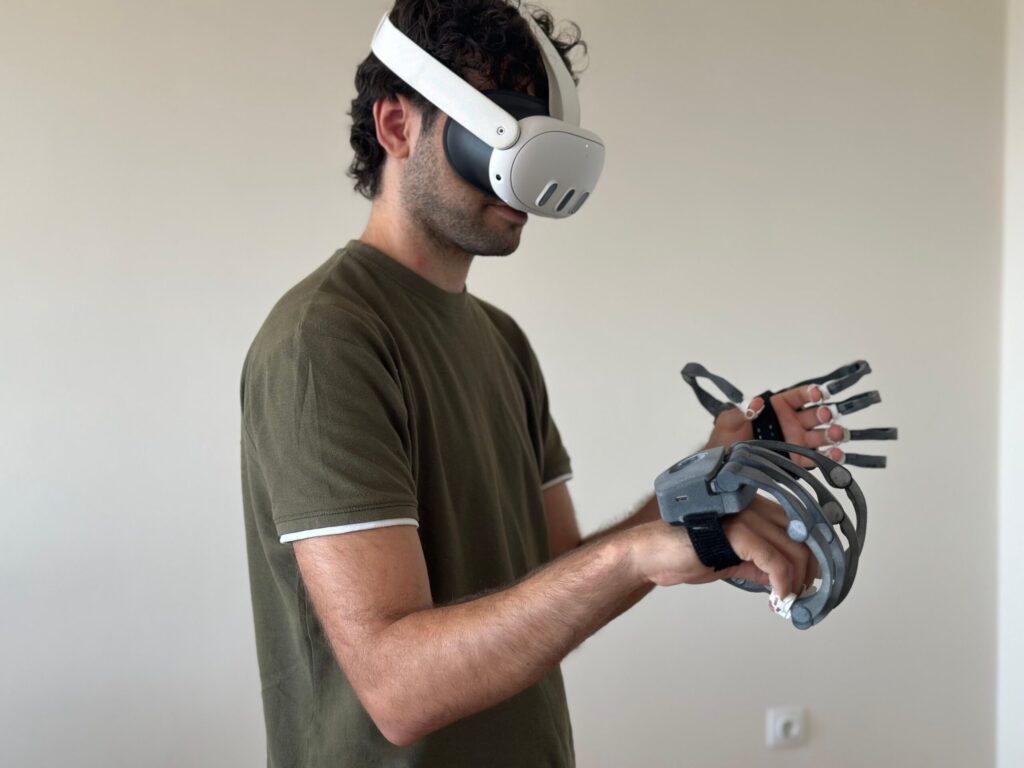 Q: What key milestones has MGL achieved, and what impact have they had?
A: Our key milestones have been:
- Completion of gesture recognition model: We captured and integrated all 15 predefined hand gestures into our system. This milestone is crucial as it provides a robust foundation for our gesture recognition capability, making it ideal for various applications in virtual reality environments.
- Development and integration of Unity package: The gesture recognition module was packaged and tested within the Unity environment, ensuring full compatibility with the CORTEX2 framework. This ensures that developers can easily incorporate our technology into their projects, promoting widespread adoption and fostering innovation across the developer community.
- Accuracy verification process: We established a method to test and confirm the accuracy of our gesture recognition system, using real-world measurements to validate the model’s performance.
These achievements collectively enhance the practical utility and reliability of the MGL project, positioning it as a cutting-edge tool for developers and researchers in immersive technologies. They significantly contribute to reducing the complexity and technical barriers previously associated with integrating advanced gesture recognition into diverse applications, thus accelerating innovation and development within the CORTEX2 ecosystem.
Q: What are MGL’s next steps?
A: Our next steps will be:
- Demonstration of gestures in a CORTEX2 scenario: In the next Sprint, we plan to demonstrate the integrated gesture recognition system within an actual CORTEX2 scenario. This will showcase its practical applications and effectiveness in real-world settings.
- Release of user manual: We will finalise and distribute a comprehensive user manual that makes it easy to create and use gestures. This manual will facilitate broader adoption and help users leverage our technology to its full potential.
- Ongoing development and refinement: We will continue to refine and enhance the system based on user feedback and integration experiences. This iterative development will ensure that the technology remains at the forefront of gesture recognition research and application.
Check out MGL’s previous interview and stay updated on its progress!
Want to know more about other CORTEX2 innovators’ updates? Browse all our supported teams on the CORTEX2 website: